

Strength in employment settles December rate debate
Raymond James Chief Economist Eugenio J. Alemán discusses current economic conditions.
The strong October nonfarm payrolls report has effectively settled the debate over what the Federal Reserve (Fed) is likely to do at its December Federal Open Market Committee (FOMC) meeting. We expect the Fed to raise the federal funds rate by another 25 basis points. Beyond December, however, the outlook remains far less certain. We continue to expect the Fed to remain on hold throughout 2027.
Job growth was broadly based across industries, with few sectors deviating from the overall trend. One notable surprise was the strength in professional and business services, which added 70,000 jobs in October. That is well above the sector's average monthly gain of roughly 15,000 jobs over the previous year. Within the sector, professional, scientific and technical services contributed 33,000 jobs, while administrative and support services, along with waste management and remediation services, added another 28,000. Given the magnitude of the increase, some statistical noise may be influencing the results. We will continue monitoring the sector to determine whether this marks a sustained shift in hiring trends.
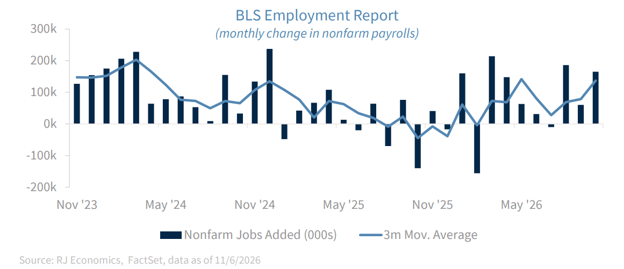
Another interesting development was the divergence between the ADP and BLS Employment Reports for manufacturing and construction employment. BLS showed manufacturing employment increasing by 19,000 jobs, while ADP reported a decline of 1,000. At the same time, BLS showed construction employment falling by 3,000, whereas ADP estimated a gain of 13,000. Manufacturing payroll gains are consistent with the ISM Manufacturing PMI employment index, while construction activity continues to benefit from the ongoing data-center boom. We will be watching these discrepancies closely to see whether future revisions reconcile the differences. That said, the two surveys draw from very different samples, so disagreements are not unusual.
High prices have no ideology
Democrats paid a political price when inflation accelerated following the pandemic, and Republicans have now experienced the same outcome. The lesson is straightforward: Americans dislike higher prices, and policies associated with rising prices often carry political consequences. In that sense, inflation and higher taxes remain among the greatest threats to incumbents. This is not a new lesson. Rather, inflation remained so subdued for so long that many policymakers forgot how costly rising prices can be politically. While inflation is generally easier to reduce once it emerges, preventing it altogether is often much more difficult, as demonstrated by the worldwide inflation surge during the post-pandemic recovery.
The Fed chair has argued on several occasions that "inflation is a choice," a characterization we disagreed with then and continue to disagree with today. Had the argument been that bringing inflation down is a choice, or that bringing it down more quickly is a choice, we would agree. The Fed possesses a powerful, but blunt, tool to combat inflation: raising interest rates enough to push the economy into recession. During the post-pandemic period, however, policymakers chose not to pursue that path. Rates were increased but not enough to derail economic growth. As a result, inflation declined gradually rather than abruptly.
Inflation was not the product of a deliberate policy decision to generate higher prices. The Fed certainly could have acted earlier and more aggressively, although doing so likely would have triggered a severe political backlash. Instead, policymakers waited too long to begin tightening and then proceeded at a pace that slowed inflation without forcing the economy into recession. Fiscal policy also played a significant role by adding fuel to already-existing inflationary pressures. It was not the only factor, but it helped keep inflation elevated for longer than otherwise would have been the case.
Today's inflation environment bears little resemblance to the post-pandemic period, not only because inflation is lower, but because its underlying drivers are different. While fiscal policy remains expansionary, as evidenced by a large fiscal deficit despite robust economic growth, today's economy is not being powered by government transfer payments. Instead, growth is being driven by a powerful investment cycle tied to artificial intelligence and data-center construction.
Fiscal policy is supporting investment directly through immediate expensing provisions and boosting consumption indirectly through stronger corporate earnings and higher equity prices. In turn, rising asset values have contributed to substantial gains in household wealth.
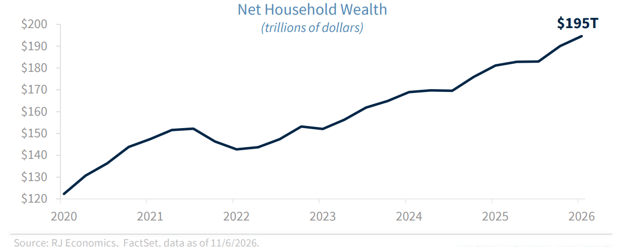
However, unlike the post-pandemic expansion, this is not a broad-based consumption boom. The benefits are concentrated in investment activity and asset ownership, which likely explains why consumer sentiment and confidence remain weaker than overall economic growth would suggest.
Bottom line
Markets can take comfort in a labor market that remains resilient and an economy supported by a powerful AI-driven investment cycle. However, while December’s FOMC rate decision appears settled, investors should focus on whether investment-led growth can continue offsetting the drag from tighter monetary policy and uneven consumer confidence in 2027.
Economic and market conditions are subject to change.
Opinions are those of Investment Strategy and not necessarily those of Raymond James and are subject to change without notice. The information has been obtained from sources considered to be reliable, but we do not guarantee that the foregoing material is accurate or complete. There is no assurance any of the trends mentioned will continue or forecasts will occur. Past performance may not be indicative of future results.
