

Businesses are not sharing the wealth with workers
Raymond James Chief Economist Eugenio J. Alemán discusses current economic conditions.
Lots has been written about the strength of the US economy not translating into improvement in the different measures of consumer confidence and consumer sentiment over the last several years. At the same time, explanations of a K-shaped economy continue to reverberate in such a way that even the US secretary of the Treasury, Scott Bessent, came out saying that the US economy, and US consumers, are doing great and that the talk about Americans not benefiting from the economy is incorrect.
It is unclear what sources the Treasury secretary is relying on for these figures, but the data we are seeing suggest a different picture and tend to agree with what consumer surveys have been showing for the last several years.
The US economy exited the COVID-19 pandemic with the need to bring back many workers who dropped from the labor force during the pandemic. Firms had to entice workers to re-engage in the economy by offering higher wages and salaries. In turn, these higher wages and salaries benefited those at the bottom of the wage spectrum the most, especially as supply-disruption-driven inflation was accelerating. This was especially true for those industries where workers could not work from home and had to have in-person contact with customers.
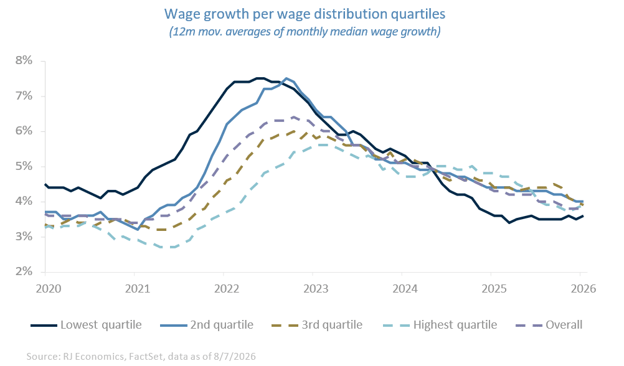
This, however, lasted until the middle of 2022, and now the lowest quartile of wage earners are doing much worse than the rest of the wage distribution. The same could be said for the second-lowest quartile, who have also benefited relatively more than higher quartiles until the middle of 2022.
Furthermore, although productivity has remained high since 2023, compensation of employees has deteriorated considerably since the recovery from the pandemic recession. This can be seen in the graph below where we show both employee compensation as a share of Gross Domestic Income (GDI) compared to corporate profits as a share of GDI.
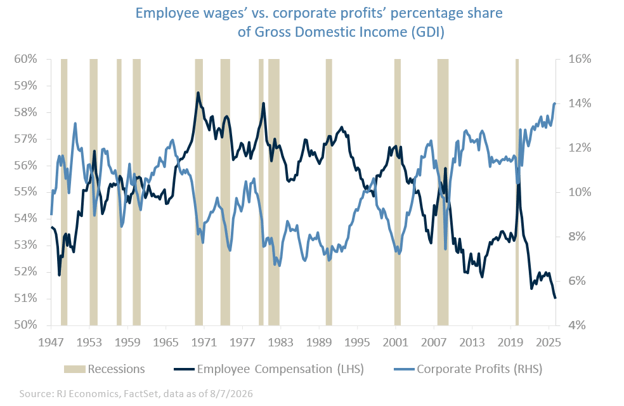
The graph shows that employees’ compensation as a share of GDI declined to an all-time low of 51%, while corporate profits as a share of GDI increased to an all-time high of 14%.
As the graph clearly shows, there is an inverse relationship between these two measures, i.e., when the share of employee compensation increases, the share of corporate profits declines and vice versa, with the employee compensation share typically increasing temporarily during recessions while the corporate profits share increases when the economy is expanding.
However, the graph also clearly shows that employees’ compensation share has been falling, on trend, since the early 2000s and hit a record historic low during the first quarter of this year. What is even more concerning is that this is happening at the same time when nonfarm labor productivity has remained strong, growing above 2.0% for almost three years.
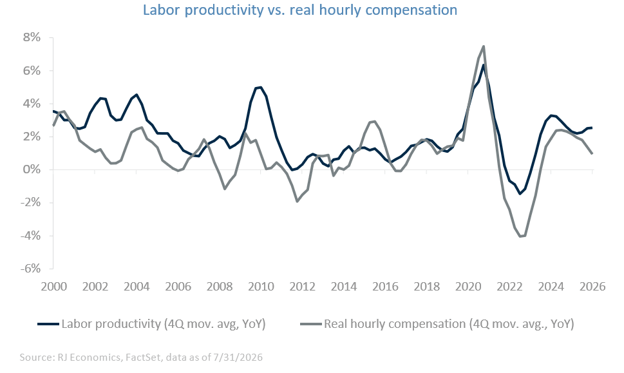
That is, the increase in labor productivity – while good for firms, the economy and inflation as it reduces inflationary pressures from wages – has been at odds with what employees are being paid. In fact, real hourly compensation of employees has been declining for over a year and is reducing the purchasing power of wages. All this could help explain why Americans remain unconvinced that this economy is helping them today.
Economic and market conditions are subject to change.
Opinions are those of Investment Strategy and not necessarily those of Raymond James and are subject to change without notice. The information has been obtained from sources considered to be reliable, but we do not guarantee that the foregoing material is accurate or complete. There is no assurance any of the trends mentioned will continue or forecasts will occur. Past performance may not be indicative of future results.
